Instructional design models can be useful when in the design process. In their 2005 book Gustafson and Branch state that instructional design models can be useful because they can “provide conceptual and communication tools that can be used to visualize, direct and manage processes for creating high-quality instruction.” (p. 1).
During the development of this program, I used an instructional design model that I designed myself. I created this model after researching various other models and realizing that other models did not quite follow the process I saw most useful for designing this program.
I designed my model as a directed non-linear model. This model allowed me the flexibility to fluidly move between steps while also being able to work through each step sequentially. While I completed these steps in sequential clockwise order, they do not need to be completed in that order. As long as all steps in the model are completed fully, a complete instruction design should be achieved.
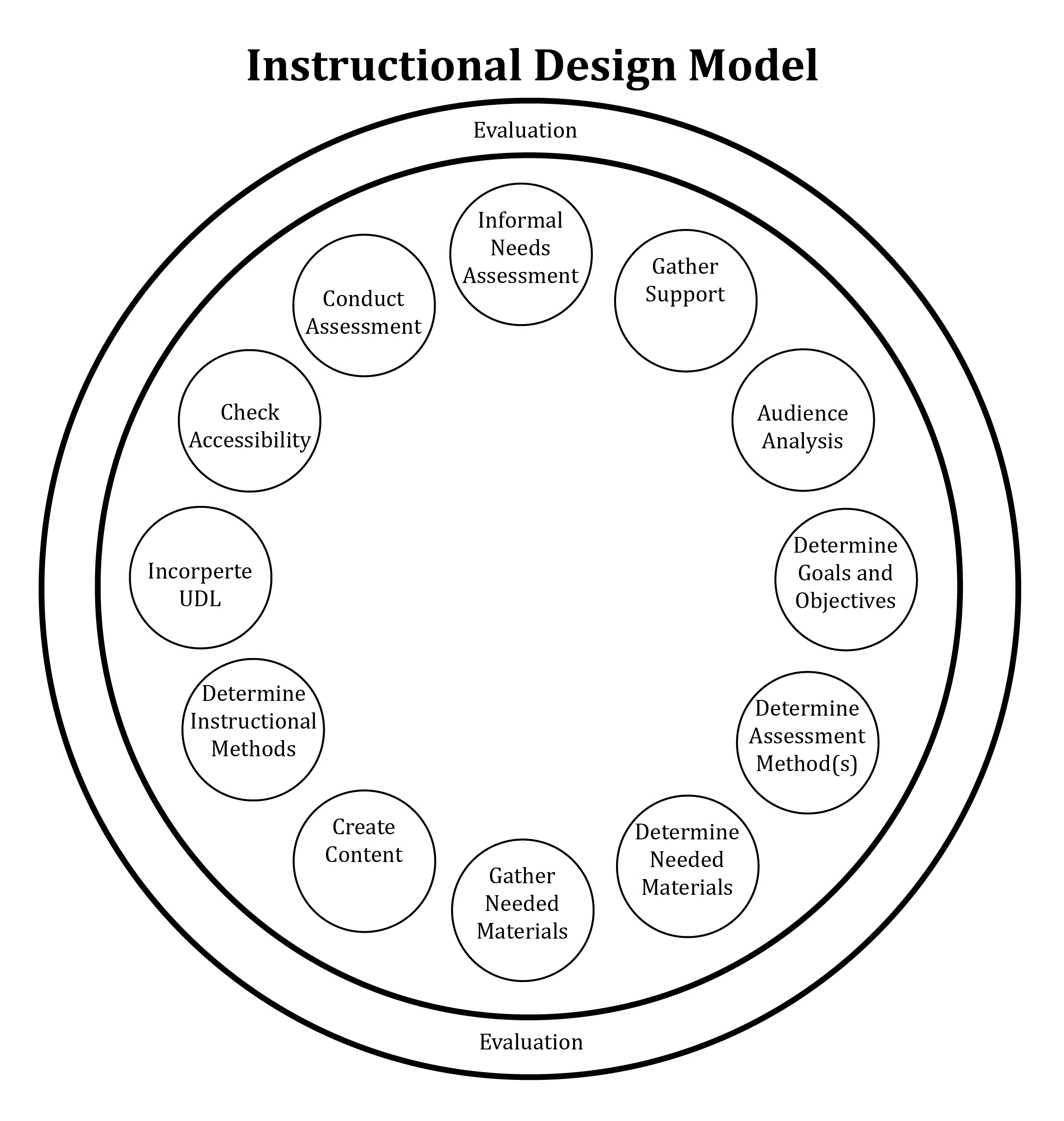
Instructional Design Steps
The steps involved in this instructional design model are:
- Informal needs assessment
- Gather support
- Audience analysis
- Determine goals and objectives
- Determine assessment method(s)
- Determine needed materials
- Gather needed materials
- Create content
- Determine instructional methods
- incorporate Universal Design for Learning (UDL)
- Check assessability
- Conduct assessment
One of the key points of this model is an ongoing evaluation. Evaluation is present throughout the process. I designed this model this way so that I would conducting evaluation throughout the process, rather than at one single point.
Learn More About This Program
Program Overview
Workshop Schedule
Goals and Objectives
Sample Materials
Assessment Plan
Evaluation Plan
Program Reflection
References
Gustafson, K.L. & Branch R.M. (2005). Survey of instructional development models (4th ed.). Syracuse NY: ERIC.
 Joe Tiner