Disability Rights | Social Justice | Student Success
Through My Eyes
Allow me to show you something, let me show you life through my eyes. When you are blind or visually impaired you experience the world in a much different way than most. You see the world from a different perspective. You learn to adapt to a world that was not designed for you. You also learn that even though one of your senses may be different, you still are able to see and do anything you want.
The purpose of this photo story is to let you see life through my eyes. In this story I will show and tell you a little bit about myself. These photos are meant to represent my life, and show you how I adapt to the world. This story is by no means comprehensive, but I hope it can give you an idea of who I am, and what my life is like.
This story is not meant evoke sympathy or pity; but rather to give you a better understanding of my life and how I interact with the world.
Please note that I am one person, and I cannot speak for all visually impaired people.
As I go through life I plan on continually add to this photo story, to show you what I experience, and how I adapt to the world.
My name is Joe Tiner and I am a senior at Colorado State University (CSU). I am majoring in Journalism and Media Communications. You may not realize it from looking at me, but I am legally blind.
I was born with a genetic degenerative eye eye disorder called Leber’s Congenital Amaurosis (LCA). This condition causes me to have decreased peripheral and central vision, as well as difficulty seeing in low light. Because of this I cannot drive, read small print, see things at far distances, or see great detail.
A lot of people tell me that I have “beautiful blue eyes”. This is one quality I really like about myself, but the ironic thing is; I really don’t know what my eyes look like. I’ve never been able to see them that well. The only way I’ve ever seen my eyes is if I enlarge a photo of my self; then I can get a general idea of what they look like, but I know it’s not the same as what others see.
One of the questions I hear a lot is “how well can you see?”. The honest answer is “I don’t know”. I’ve never had full vision, so I don’t have anything to compare my vision to. The best way I can describe it is that I get the gist of things. For example, I get an overall idea of what someone looks like, but I cannot see any detail. I might see that someone is tall with dark hair, but I won’t be able to tell what color theri eyes are.
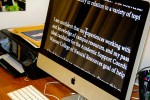
In order for me to use a computer, or any piece of technology, I need to rely on assistive technology. I use magnification program that enlarges what is on the screen as much as I need it. I also prefer to invert the color scheme so that white text appears on a black background. These two things make accessing information so much easier.
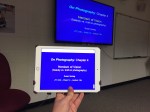
I am fortunate to live in a place and time where information is easily shared and accessible. When I am in class one of the ways I access the information the professor is presenting is by having them email me a copy of their lecture slides. I am able to pull this up on my iPad and enlarge it as large as I need.
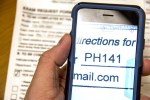
While I can use a computer to access most information and printed materials that I need to read, there are still some things that I cannot get electronically. One way I access these documents is by using an app on my phone that uses my phone’s camera to create a hand-held magnifier. This is not the most effective way of accessing printed documents, but it is great for quick skimming.
When it is dark out, I am in a low lit area, or when I am in an unfamiliar area I use a mobility cane to help me navigate around. The cane acts an extension of my body and helps me by allowing me to feel if there is something in front of me, that way I can navigate around it.
Because I am reliant on my cane when I am in dark or unfamiliar areas I almost always have it with me. I usually have it in my backpack or in my back pocket, that way if need be I can pull it out and utilize it. I am very surprised how often people ask me what is in my pocket. I’ve even had people see it and think it is a pair of nunchakus.
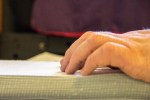
Braille is a series of raised dots that create a written language that is accessible to those who are blind. I began learning Braille when I was five, and spent ten years learning it. However, because of the advance in assistive technology I very rarely use Braille anymore. But, I still try to retain my understanding of it, just in case I ever need to use it.
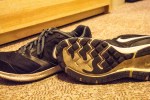
Because I am not able to drive I am primarily reliant on alternative forms of transportation. One of the forms I use most is my own feet. Whether it is to class, work, or the bus stop; I primarily walk the places I need to go. This leads to a lot of wear and tear on my shoes.
One thing Fort Collins has that I have never seen anywhere else is talking sidewalk-crossing signals. These signals go a step past the traditional beeping signals. I find these signals extremely helpful because they tell you not only when to cross, but also what street your crossing. They are also less confusing because they speak to you from right next to you, rather than from beeping at you from across the street.
Other than my feet, one of the other forms of transportation I utilize the most is the MAX Rapid Transit System. I find this bus extremely convenient and accessible because it allows me to easily get from one place to another. The fact that it runs quite frequently along a set stretch of the Mason corridor makes it extremely easy to use.
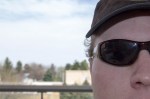
One thing I don’t think people realize is that I have to wear a hat and/or sunglasses whenever I go outside. I have to do this because my eyes are extremely sensitive to the bright sunlight. I have to be protective of my eyes so that my vision does not deteriorate any faster.
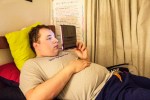
I am able to use my iPad as a tool to help me access many different things. One of the things I use it for that I enjoy is most is watching TV and movies. Because it’s so light and portable I can hold it as close as I need to be able to see a good amount of what is happening on the screen; and if needed I can pause what I’m watching to get a better look at it. Additionally, recently Netflix and other streaming services have began including audio descriptions on their programming which increases my access to the content by allowing me to get audio descriptions of what is happening on the screen.
Because my vision is limited I use my camera to help me see the world. My camera acts as a third eye for me. I am able to photograph something and when I download it and enlarge it, I am able to see things I would have never seen with my eyes.
I was given this plaque by my former newspaper and yearbook advisors when I graduated high school. I really love it because it really captures a part of me that I have always believed; even though my sight may be limited it does not stop me from seeing. I can still see, I just have to see in a different way. I see through touch, smell, sound, taste, and through my mind’s eye. “I see only different”.
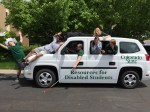
Being legally blind has taught me many things. It has taught me to see the world in new ways. It has taught me that there is always a way to do what you want, you just have to look for it. But most importantly it has taught me that life is a wild and crazy ride, and sometimes you just need to laugh at yourself. Photo by Allison Penfield (I did not take this photo, but I felt it captured a really important piece of who I am.)









 Joe Tiner